Newer versions of GAMS allow UTF-8 encoded strings as labels. That is very welcome, as these labels may come from data sources that just use Unicode characters. However, when printing to the listing file, we miss proper Unicode support. At first, I thought, "OK, just a few misaligned tables. No big deal." Here is a constructed example showing this may be a bit more problematic.
Monday, January 8, 2024


Thursday, January 4, 2024
String Art
In [1], a greyscale picture is approximated by strings (lines) between points around the image. Here, I will try something similar with a formal optimization model.
Sunday, November 19, 2023
Grouping items: a difficult combinatorial problem
In [1], a simple problem is described:
- We have \(n\) items (or orders) with a certain width.
- We need to combine these items in groups (called patterns) with rather tight limits on the total width. The total length of a pattern (the sum of the lengths of the items assigned to this pattern) must be between 335 and 340.
- As a result, we may not be able to assign all items. The remaining items cannot be formed into valid patterns.
- The objective is to try to place as many items as possible into patterns.
- An indication of the size of the problem: \(n \approx 500\).
Data
Instead of immediately working on a full-known \(n=500\) problem, I generated a random data set with a very manageable \(n=50\) items. The widths were drawn from a discrete uniform distribution between 30 and 300. The data looks like:
----     15 PARAMETER w  item widths

order1   76.000,    order2  258.000,    order3  179.000,    order4  111.000,    order5  109.000,    order6   90.000
order7  124.000,    order8  262.000,    order9   48.000,    order10 165.000,    order11 300.000,    order12 186.000
order13 298.000,    order14 236.000,    order15  65.000,    order16 203.000,    order17  73.000,    order18  97.000
order19 211.000,    order20 147.000,    order21 127.000,    order22 125.000,    order23  65.000,    order24  70.000
order25 189.000,    order26 255.000,    order27  92.000,    order28 210.000,    order29 240.000,    order30 112.000
order31  59.000,    order32 166.000,    order33  73.000,    order34 266.000,    order35 101.000,    order36 107.000
order37 190.000,    order38 225.000,    order39 200.000,    order40 155.000,    order41 142.000,    order42  61.000
order43 115.000,    order44  42.000,    order45 121.000,    order46  79.000,    order47 204.000,    order48 181.000
order49 238.000,    order50 110.000
I stick to the pattern limits \(\color{darkblue}L=335\) and \(\color{darkblue}U=340\).
We need some estimate of the number of patterns to use. We could just guess. But a better approach is the following. An upper bound for the number patterns can be established quite easily: \[{\mathit{maxj}} = \left\lfloor \frac{\sum_i \color{darkblue}w_i}{\color{darkblue}L}\right\rfloor\] For our data set this number is:
---- 29 PARAMETER maxj = 22.000 max number of patterns we can fill
This means we can safely use this number as the number of bins (patterns).
Saturday, October 21, 2023
Scheduling Team Meetings
This is a simple problem from [1]:
I'm rusty on constraint optimization and am looking for help in this particularuse case. There are individuals who are each member to several teams. This is afixed many-to-many relationship and is determined a-priori. There are 3 timeslots where the teams can be scheduled to conduct a business meeting, but if anindividual is a member of more than one team which are both meeting at a giventime slot, they'll only be able to attend one. The objective is to schedule theteams into the time slots, minimizing the number of overlaps of individuals.
For beginners, it is often a good idea to split the task in two:
- Formulate a mathematical model (on a piece of paper)
- Implement the model in code
Friday, October 20, 2023
GAMS: SMAX and sparsity
This is a discussion about the SMAX function in GAMS and how it behaves for sparse data.
The data structure we were facing was something like:
seti 'cases' /case1*case100000/j 'attribute' /j1*j25/k 'attribute' /k1*k25/t 'type' /typ1*typ2/;parameter p(i,j,k,t) 'positive numbers';* note: for each i we have only one (j,k)
Thursday, October 19, 2023
Plotting NUTS-2 maps from GAMS
NUTS-2 regions are statistical subnational regions (often provinces), mainly for the EU and UK [1].
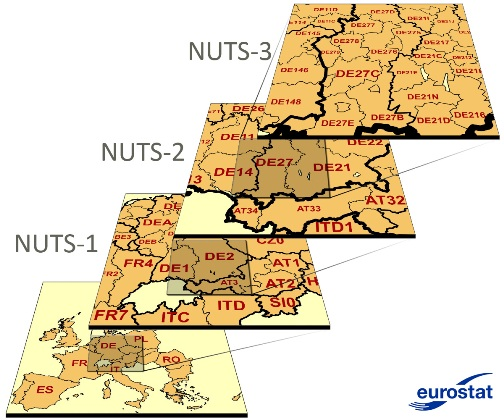 |
| NUTS hierarchy (from [1]) |
In [2] we can find mapping information in the form of Shapefiles[3] and related formats. I used the GeoJSON[4] format, and created a Python notebook script to extract a GAMS set from that file. The file is reproduced in the appendix below. The NUTS-2 codes form the set elements, and the name is stored as explanatory text. There is an option to generate Latin names instead of using the native alphabet. The Latin names are also inside the geojson file. E.g. we have:
EL65 'Πελοπόννησος'
which is in the Greek alphabet. Using the Latin name, this would look like:
EL65 'Peloponnisos'
Thursday, October 5, 2023
Linear Programming Nonsense?
1. Inventory balance constraints
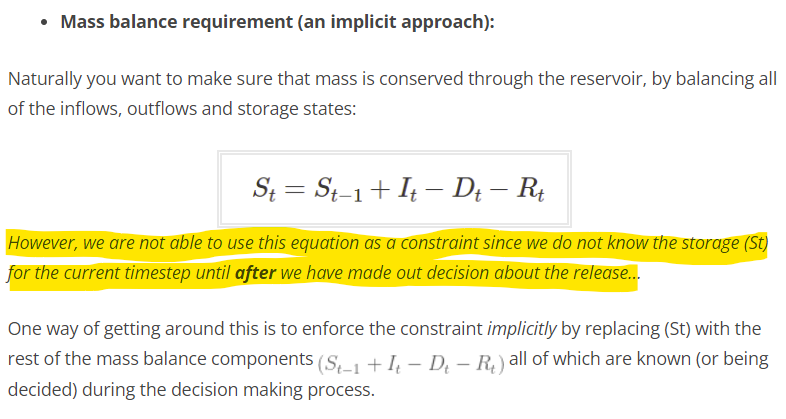 |
| Inventory Balance Constraint |
Wednesday, September 27, 2023
Math and ChatGPT
Performing symbolic math steps is often related to pattern recognition. In theory, ChatGPT could be doing a good job here. I wanted to find the inverse of \[f(x) = {\mathrm{sign}}(x) \log(1+|x|)\] This function is a form of a signed logarithmic scaling. So, let's see what ChatGPT is telling us:
Wednesday, September 20, 2023
Julia vs Python
I gave a talk to economists (i.e., not professional programmers) about a Julia project we were working on. Julia is famous for its speed. It uses LLVM [1] as back-end for its JIT (Just In Time) compilation. As seeing is believing, here is an example algorithm which is used to compare performance between different languages and tools. This example was chosen as it is small, easy to explain, and easy to program while still showing meaningful time differences.
We have a square \([-1,+1]\times[-1,+1]\) and an inscribing circle with radius \(1\). See the dynamic figure below. Their areas are \(4\) and \(\pi\) respectively. The idea is to draw \(n\) points \[\begin{align}& x_i \sim U(-1,+1) \\ & y_i \sim U(-1,+1)\end{align}\]Let \(m\) be the number of points inside the circle, i.e. with \[x_i^2+y_i^2\lt 1\] Obviously, from the ratio of the areas, we have \[\frac{m}{n} \approx \frac{\pi}{4}\] It follows that an estimate of \(\pi\) is \[\hat{\pi}=4\frac{m}{n}\]
 |
| Simulation with n=1000 |
Monday, September 4, 2023
Critiquing a GAMS Model
It is always interesting to read GAMS models written by someone else. There are probably three things one can observe:
- A nice formulation or concept that is useful to learn about.
- A bad implementation: something that really should not be done that way.
- A piece of code that is correct and defensible, but I would write it differently. This includes things like style, layout, formatting, etc.
My way of reading GAMS code is often to start editing and make it "my code". It is a bit slower process, but that comes with its advantages: better understanding of what is going on, and often cleaner code.
Here, I am looking at the model sambal.gms in the GAMS model library [1]. It is a very small model, but I have many thoughts about it. The complete model is reproduced in Appendix 1. Let's walk through it.
The matrix balancing problem is to find a nearby matrix such that row- and column sums are obeyed. A relative quadratic objective is used to minimize the sum of the squared deviations between the original data (the priors) and the final matrix. Zeros in the matrix need to be maintained: they can't become nonzero. This is sometimes called sparsity preservation. Often, sign-preservation is another condition. That is not part of this model. Note that, in this model, not only the matrix is updated but also the row and column totals.
Subscribe to:
Posts (Atom)