Showing posts with label Matrix balancing. Show all posts

Monday, September 4, 2023

Critiquing a GAMS Model

It is always interesting to read GAMS models written by someone else. There are probably three things one can observe:

  • A nice formulation or concept that is useful to learn about.
  • A bad implementation: something that really should not be done that way.
  • A piece of code that is correct and defensible, but I would write it differently. This includes things like style, layout, formatting, etc.
My way of reading GAMS code is often to start editing and make it "my code". It is a bit slower process, but that comes with its advantages: better understanding of what is going on, and often cleaner code.

Here, I am looking at the model sambal.gms in the GAMS model library [1]. It is a very small model, but I have many thoughts about it. The complete model is reproduced in Appendix 1. Let's walk through it.

The matrix balancing problem is to find a nearby matrix such that row- and column sums are obeyed. A relative quadratic objective is used to minimize the sum of the squared deviations between the original data (the priors) and the final matrix. Zeros in the matrix need to be maintained: they can't become nonzero. This is sometimes called sparsity preservation. Often, sign-preservation is another condition. That is not part of this model. Note that, in this model, not only the matrix is updated but also the row and column totals. 

Tuesday, August 29, 2023

Three-level Matrix Balancing

Matrix balancing: introduction

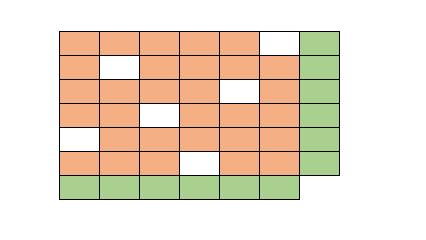
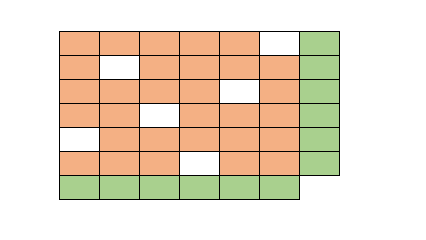
Matrix Balancing Models are often used in economic modeling exercises: they create consistent data sets from data originating from different, conflicting data sources. A standard example is updating a matrix subject to given row and column sums. An example can look like:

Update orange cells subject to row/column sums


The empty cells are zero, and they should remain zero. In other words, we need to preserve sparsity. Often, we have non-negativity restrictions on the values. The mathematical model can look like this:

Saturday, December 17, 2022

Comparing matrix balancing objectives

The matrix balancing problem can be described as [1]: find a non-negative matrix \(\color{darkred}A_{i,j}\), that is as close as possible to \(\color{darkblue}A^0_{i,j}\), while observing given row and column totals and a given sparsity pattern. Or, mathematically,


Matrix Balancing Problem
\[\begin{align}\min_{\color{darkred}A}\>&{\bf{dist}}(\color{darkred}A,\color{darkblue}A^0)\\ & \sum_i \color{darkred}A_{i,j} = \color{darkblue}c_j && \forall j\\ & \sum_j \color{darkred}A_{i,j} = \color{darkblue}r_i && \forall i \\&\color{darkred}A_{i,j}=0 &&\forall i,j|\color{darkblue}A^0_{i,j}=0\\ &\color{darkred}A_{i,j}\ge 0 \end{align} \]

Thursday, August 25, 2022

Some Matrix Balancing Experiments

This is about the matrix balancing problem.

We have three sets of data:
  • A matrix with with entries \(\color{darkblue}A^0_{i,j}\ge 0\). 
  • Row- and column-totals \(\color{darkblue}r_i\) and  \(\color{darkblue}c_j\).
The \(\color{darkblue}A^0\) matrix is collected from different sources than the row- and column-totals. So the matrix elements don't sum up to our totals. The problem is finding a nearby matrix \(\color{darkred}A\), so the row and column totals are obeyed. In addition, we want to preserve the sparsity pattern of  \(\color{darkblue}A^0\): zeros should stay zero. And also: we don't want to introduce negative numbers (preserve the signs). More formally:


Matrix Balancing Problem
\[\begin{align}\min\>&{\bf{dist}}(\color{darkred}A,\color{darkblue}A^0)\\ & \sum_i \color{darkred}A_{i,j} = \color{darkblue}c_j && \forall j\\ & \sum_j \color{darkred}A_{i,j} = \color{darkblue}r_i && \forall i \\&\color{darkred}A_{i,j}=0 &&\forall i,j|\color{darkblue}A^0_{i,j}=0\\ &\color{darkred}A_{i,j}\ge 0 \end{align} \]


Approximate the matrix subject to row- and column-sum constraints