In this puzzle [1,2], we need to determine what the 3-digit passcode is, using a few hints. Each digit is an integer between 0 and 9. The hints are:

Let's see if we can shoehorn this into a MIP model.
In this puzzle [1,2], we need to determine what the 3-digit passcode is, using a few hints. Each digit is an integer between 0 and 9. The hints are:
Let's see if we can shoehorn this into a MIP model.
 |
| Random Demand Points |
 |
| A standard problem with 4 disks requires 15 moves |
The towers of Hanoi problem [1] is a famous puzzle demonstrating recursion. The task is to move a stack of disks from one peg to another. We can only move one disk at a time, and we need to obey the rule that larger disks can never be on top of a smaller disk. The moves for the 3 disk problem are:

The Wolf, goat, and cabbage problem can be stated as [1]:
A farmer with a wolf, a goat, and a cabbage must cross a river by boat. The boat can carry only the farmer and a single item. If left unattended together, the wolf would eat the goat, or the goat would eat the cabbage. How can they cross the river without anything being eaten?
A long transcontinental flight was a good opportunity to try to attack this problem. Here are some approaches to model this. Not at all a very useful or practical model, but still interesting, I think (although I may be in a small minority here).
In this model, we keep track of the inventory of items (wolf, goat, cabbage). We assume the starting inventory is: all items are on the left bank of the river. The final inventory should be: all items are on the right bank. In this model, I assume the following numbering scheme:
----     31 SET trip  trips

trip1 ,    trip2 ,    trip3 ,    trip4 ,    trip5 ,    trip6 ,    trip7 ,    trip8 ,    trip9 ,    trip10


----     31 SET dir  direction of trip

L->R,    R->L


----     31 SET tripDir  trip direction combos

              L->R        R->L

trip1          YES
trip2                      YES
trip3          YES
trip4                      YES
trip5          YES
trip6                      YES
trip7          YES
trip8                      YES
trip9          YES
trip10                     YES

| Model 1: standard min-cost flow network model |
|---|
| \[\begin{align}\min& \sum_{(i,j)\in A}\color{darkblue}c_{i,j}\cdot\color{darkred}f_{i,j}\\ & \sum_{j|(j,i)\in A}\color{darkred}f_{j,i} + \color{darkblue}{\mathit{supply}}_i = \sum_{j|(i,j)\in A}\color{darkred}f_{i,j} + \color{darkblue}{\mathit{demand}}_i && \forall i \\ & \color{darkred}f_{i,j} \in [0,\color{darkblue}{\mathit{capacity}}_{i,j}] \end{align}\] |
This is not, per se, very useful, but sorting a parameter inside a MIP model is not very easy for MIP solvers. Obviously, if you need a sorted parameter in the model, it is better to use a sorting algorithm. But useless models can still be interesting.
I use:
Input: a 1-dimensional parameter with values.
Output: a 1-dimensional variable with the values sorted in ascending order.
We can implement this with a permutation matrix \(\color{darkred}X\), which is a permuted identity matrix. In a MIP context, this becomes a binary variable with some assignment constraints.
| MIP Model for sorting \(p_i\) |
|---|
| \[\begin{align}\min\>&\color{darkred}z=0\\& \sum_i \color{darkred}x_{i,j} = 1&&\forall j\\ & \sum_j \color{darkred}x_{i,j} = 1&&\forall i\\ & \color{darkred}y_i = \sum_j \color{darkred}x_{i,j}\cdot\color{darkblue}p_j\\& \color{darkred}y_i \ge \color{darkred}y_{i-1}\\ & \color{darkred}x_{i,j} \in \{0,1\}\end{align}\] |
In optimization models, we often use an aggregate measure in the objective function, such as total profit, the sum of tardiness of jobs, and countrywide GDP. This can lead to particularly bad results for some individuals or groups.
Here is an example I have used on several occasions.
We have \(P\) persons. They must be assigned to \(M\) groups or teams. For simplicity, we can assume \(n\) is a multiple of \(m\), and the group size is \[\frac{N}{M}\] Each person \(p_1\) specifies some preferences to be placed in the same group as a person \(p_2\). A negative preference can be used to indicate that I prefer to be in a different group. Find an optimal assignment taking into account these preferences.
Here is an example where the PuLP modeling tool goes berserk.
In standard linear programming, only \(\ge\), \(=\) and \(\le\) constraints are supported. Some tools also allow \(\ne\), which for MIP models needs to be reformulated into a disjunctive constraint. Here is an attempt to do this in PuLP [1]. PuLP does not support this relational operator in its constraints, so we would expect a meaningful error message.
| High-Level Model |
|---|
| \[\begin{align} \min\> & \sum_i | \color{darkblue}a_i\cdot \color{darkred}x_i| \\ & \max_i |\color{darkred}x_i| = 1 \\ & \color{darkred}x_i \in \{-1,0,1\} \end{align}\] |
A programmer writes about this blog:

In [1], the following Pyomo model (Python fragment) is presented:
model.x = Var(name="Number of batches", domain=NonNegativeIntegers, initialize=10)
model.a = Var(name="Batch Size", domain=NonNegativeIntegers, bounds=(5,20))

# Objective function
def total_production(model):
    return model.x * model.a
model.total_production = Objective(rule=total_production, sense=minimize)

# Constraints
# Minimum production of the two output products
def first_material_constraint_rule(model):
    return sum(0.2 * model.a * i for i in range(1, value(model.x)+1)) >= 70
model.first_material_constraint = Constraint(rule=first_material_constraint_rule)

def second_material_constraint_rule(model):
    return sum(0.8 * model.a * i for i in range(1, value(model.x)+1)) >= 90
model.second_material_constraint = Constraint(rule=second_material_constraint_rule)

# At least one production run
def min_production_rule(model):
    return model.x >= 1
model.min_production = Constraint(rule=min_production_rule)
In [1], a greyscale picture is approximated by strings (lines) between points around the image. Here, I will try something similar with a formal optimization model.
This is a simple problem from [1]:
I'm rusty on constraint optimization and am looking for help in this particularuse case. There are individuals who are each member to several teams. This is afixed many-to-many relationship and is determined a-priori. There are 3 timeslots where the teams can be scheduled to conduct a business meeting, but if anindividual is a member of more than one team which are both meeting at a giventime slot, they'll only be able to attend one. The objective is to schedule theteams into the time slots, minimizing the number of overlaps of individuals.
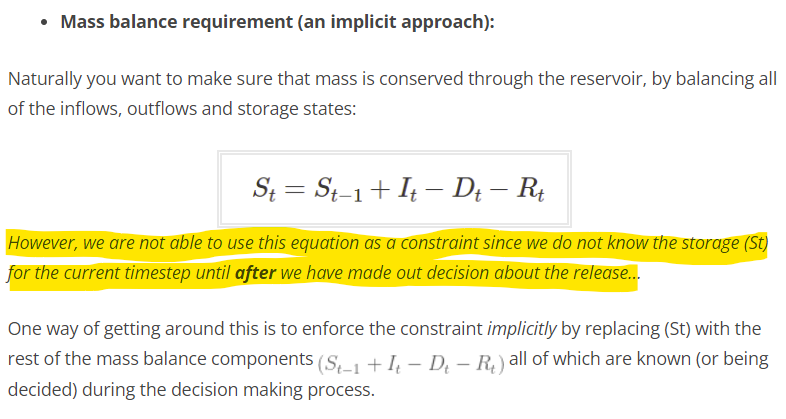 |
| Inventory Balance Constraint |
In [1], the following problem is stated:
Given a boolean matrix, with \(m\) rows and \(n\) columns, find the largest pattern of ones that is found in at least \(\color{darkblue}K\) rows. We can ignore cells where the pattern has a zero value: they don't count.
A small example [1] is given:
row 1:[0, 1, 0, 1, 1, 0, 1, 0, 1, 0, 1, 1, 1, 0, 1, 0, 0, 0, 1, 0, 1]
row 2:[0, 1, 0, 1, 1, 0, 0, 1, 0, 1, 0, 1, 0, 0, 0, 1, 1, 1, 0, 1, 1]
row 3:[0, 0, 0, 1, 1, 0, 0, 1, 0, 0, 0, 1, 0, 0, 1, 0, 1, 1, 0, 0, 1]
row 4:[1, 1, 0, 1, 1, 1, 0, 1, 0, 0, 0, 1, 1, 1, 0, 0, 0, 0, 0, 1, 1]
row 5:[1, 1, 0, 1, 1, 1, 0, 0, 0, 0, 0, 1, 1, 1, 0, 0, 0, 1, 0, 1, 1]
row 6:[1, 1, 1, 1, 1, 1, 0, 0, 0, 0, 0, 1, 1, 1, 0, 0, 0, 0, 0, 1, 1]
row 1:  [0, 1, 0, 1, 1, 0, 1, 0, 1, 0, 1, 1, 1, 0, 1, 0, 0, 0, 1, 0, 1]
row 2:  [0, 1, 0, 1, 1, 0, 0, 1, 0, 1, 0, 1, 0, 0, 0, 1, 1, 1, 0, 1, 1]
row 3:  [0, 0, 0, 1, 1, 0, 0, 1, 0, 0, 0, 1, 0, 0, 1, 0, 1, 1, 0, 0, 1]
row 4:  [1, 1, 0, 1, 1, 1, 0, 1, 0, 0, 0, 1, 1, 1, 0, 0, 0, 0, 0, 1, 1]
row 5:  [1, 1, 0, 1, 1, 1, 0, 0, 0, 0, 0, 1, 1, 1, 0, 0, 0, 1, 0, 1, 1]
row 6:  [1, 1, 1, 1, 1, 1, 0, 0, 0, 0, 0, 1, 1, 1, 0, 0, 0, 0, 0, 1, 1]
pattern:[1, 1, 0, 1, 1, 1, 0, 0, 0, 0, 0, 1, 1, 1, 0, 0, 0, 0, 0, 1, 1]
Here we consider the following problem from [1]:

